
Can a browser wallet really stop blind signing and save you from a catastrophic DeFi mistake?
Why swap tools, DeFi rails, and a clean portfolio tracker are the wallet features you’ll actually use
octombrie 3, 2025Why „I can’t use Trust Wallet in my browser” is usually the wrong complaint — and what to do about it
februarie 22, 2026That question reframes a familiar decision: when you choose a browser wallet, are you buying convenience, or are you buying genuine risk reduction? For DeFi power users who routinely interact with multiple EVM chains, the practical answer hinges on two mechanisms: what the wallet shows you before you sign, and what it can do to limit the attack surface after you press confirm. Rabby frames itself around those mechanisms — transaction simulation, pre-signature risk scanning, revocation tools, and automatic network handling — and those features change the calculus of operational security. But they do not eliminate human error or systemic risks. Understanding how they work, where they help most, and where they leave gaps is what allows a trader, LP, or treasurer to make a defensible choice.
In the U.S. context — where institutional compliance, AML tailwinds, and custody alternatives influence operational design — a non-custodial browser wallet still has to solve practical problems that custodial providers hide. For power users who hold diverse positions across Ethereum, Arbitrum, Optimism, BNB Chain, Polygon and dozens of other EVM networks, the salient questions are: will the wallet prevent blind-signing surprises, reduce approval exposure, and simplify cross-chain friction without creating new hidden weaknesses?
How Rabby’s core mechanisms change the signing decision
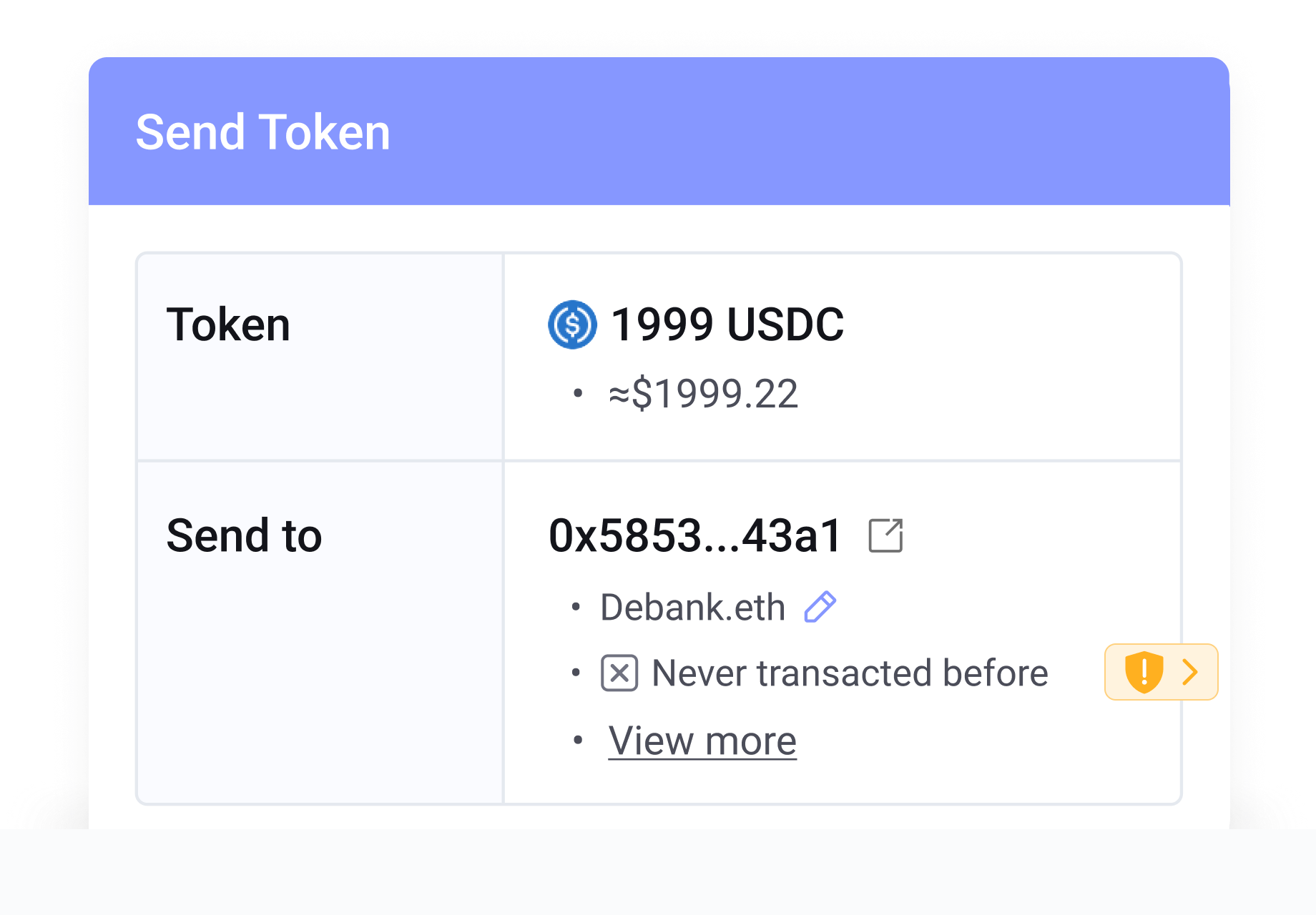
Three technical primitives underpin Rabby’s pitch to DeFi power users: transaction simulation, pre-transaction risk scanning, and approval management. Transaction simulation runs the requested transaction through a local or deterministic model of the smart contract call and displays expected token balance deltas and costs before you sign. Mechanistically, that’s a short-circuit against „blind signing” — if a contract call would sweep your token balance, the simulation can surface that before you consent.
Pre-transaction risk scanning layers on heuristics and threat intelligence: checking whether the target contract has a history of hacks, whether the approval request is unusually broad (infinite allowance), or whether the recipient address is plainly nonexistent. Approval revocation is the containment control: if you discover an old dApp has an approval that you no longer need, Rabby exposes a revocation flow so you can narrow or cancel allowances without interacting with the original dApp again.
There are clear trade-offs. The simulation depends on accurate state and the ability to model side effects; complex contracts that call external systems or rely on off-chain oracles may still produce surprising results. The scanner depends on up-to-date threat intelligence and heuristics; novel or subtly malicious contracts can evade pattern-based detection. So these mechanisms reduce, but do not eliminate, the probability of loss from signing dangerous transactions.
What Rabby offers beyond the simulation: multi-chain ergonomics and institutional hooks
Rabby is built as a multi-chain wallet supporting over 90 EVM-compatible blockchains. For active users who deploy across Layer 2s and alternative EVMs, two conveniences materially affect daily operational risk: automatic network switching and cross-chain gas top-up. Automatic network switching means the extension detects the dApp’s intended chain and flips networks for you; this reduces user mistakes like signing a transaction on the wrong chain or having the wrong gas token selected when approving. Cross-chain gas top-up addresses a procedural friction: if you need to interact on a sidechain but hold no gas there, the wallet can top up gas tokens so the action completes, avoiding risky ad hoc workarounds.
For teams and higher-assurance users, Rabby integrates with multi-sig and enterprise services such as Gnosis Safe and custodial enterprise providers like Fireblocks (integration capability noted in the product literature). That matters because for treasury operations or institutional liquidity providers, the choice is rarely between „non-custodial individual wallet” and nothing; it’s about how a browser wallet can be composed into a higher-assurance stack.
Rabby’s open-source MIT license matters for security culture: independent audits and community inspection are possible and encouraged. Yet openness is a necessary, not sufficient, condition for security. The project’s history — notably the 2022 Rabby Swap contract exploit (~$190,000) that led the team to freeze the contract and compensate users — is instructive. It shows both the inevitability of bugs in complex DeFi software and the value of rapid incident response and post-incident hardening. It also reminds users that a wallet vendor’s accountability and operational maturity matter as much as feature lists.
Common misconceptions, corrected
Misconception 1: „A simulation makes signing safe.” Correction: simulation is a powerful mitigation for common classes of exploit (token drains, mispriced swaps, incorrect allowances), but it can be blind to on-chain–off-chain interactions, front-running, MEV sandwich strategies, and complex multi-contract flows that depend on changing state between simulation and execution. Treat simulation as a last-mile transparency tool, not an oracle of absolute safety.
Misconception 2: „If a wallet is open-source, it’s secure.” Correction: open-source increases the opportunity for audit and community scrutiny, but security depends on active auditing, patch speed, and secure defaults. The 2022 exploit shows that even projects with open codefaces can suffer vulnerabilities; the practical question is how the team remediates, communicates, and reduces recurrence.
Misconception 3: „Automatic network switching removes user error.” Correction: it reduces certain manual errors (wrong-chain confirmations), but automatic switching increases the importance of UI clarity. Users must still verify destination chain and token, because automatic behavior shifts the trust boundary from the user’s manual action to the extension’s correctness and detection heuristics.
Where Rabby stops and what users must still control
Operational discipline remains the dominant control for sophisticated users. Rabby removes common pains — multi-chain juggling, blind-sign risk, approval clutter — but it doesn’t create a vault that prevents social engineering, phishing of seed phrases, or hardware wallet compromise. The wallet supports hardware devices (Ledger, Trezor, Keystone, etc.), and combining Rabby’s simulation with a hardware signer is a strong defense-in-depth pattern: use Rabby for visible pre-signature simulation and a hardware wallet so that private keys never leave a secure element.
Two material limitations to keep in mind: Rabby does not offer an in-wallet fiat on-ramp, so acquiring on-ramps requires external exchanges or third-party integrations, which introduces custody and compliance considerations chosen by the user. Rabby also does not natively provide staking flows inside the wallet; staking requires external dApps or dedicated staking interfaces. For U.S.-based users subject to certain compliance regimes or corporate treasury rules, these gaps affect operational workflows and audit trails.
Decision-useful framework: When to pick Rabby for your daily DeFi operations
Use Rabby if you: manage positions across many EVM chains and value automatic network handling; want pre-signature simulations to reduce blind-signing risk; need revocation tools to shrink attack surfaces quickly; integrate hardware wallets and multi-sig for higher assurance. Rabby is particularly sensible for traders, arbitrageurs, and active LPs who must sign many transactions across chains and need a visible, quick check on what each transaction will do.
Prefer alternatives (or additional controls) if you: require built-in fiat on-ramps or in-wallet staking; prioritize a mobile-first custodial experience where provider-side compliance is required; or operate under a corporate policy that disallows browser-extension wallets entirely. In those cases, a combination of custody solutions plus a controlled multi-sig workflow could be preferable.
Heuristic to reuse: treat simulation as „reality check” + approval revocation as „containment.” When you interact with a new dApp, first inspect the simulation output for balance deltas and fee expectations; second, avoid infinite approvals; third, if you grant an approval for convenience, schedule a revocation immediately afterward or use a time-limited or minimal allowance pattern.
What to watch next
Three signals will determine whether this style of wallet increasingly displaces older patterns. First, the accuracy and expressiveness of simulation tooling: can wallets model cross-contract and oracle-dependent flows with enough fidelity? Second, the maturation of threat intelligence for pre-signature scanning — better indicators will reduce false negatives without drowning users in false positives. Third, regulatory and institutional adoption: if enterprise integrations and compliance features continue to evolve, browser wallets that compose into custody and multi-sig stacks will gain traction among U.S.-based funds and treasuries. Each of these is conditional; improvements require engineering resources, data sharing, and industry coordination.
FAQ
Does Rabby stop all phishing and contract-based exploits?
No. Rabby reduces risk by simulating transactions and flagging suspicious approvals or contracts, but phishing (seed phrase theft), social-engineered approvals, and exploits that depend on off-chain data or time-sensitive state changes are not fully prevented by any browser wallet alone. Combine Rabby’s protections with a hardware wallet and strict operational procedures.
Can I use Rabby with hardware wallets and multi-sig setups?
Yes. Rabby supports Ledger, Trezor, Keystone and other hardware devices and integrates with multi-signature and enterprise solutions like Gnosis Safe and Fireblocks, allowing you to build layered controls appropriate for institutional or high-value personal use.
Is the transaction simulation always correct?
Simulations are a deterministic model based on current chain state and the contract code path as understood by the wallet. They are highly useful for catching obvious drains and fee surprises but can fail when external oracles, on-chain reordering (MEV), or subsequent state changes alter the execution path between simulation and settlement.
Where can I download Rabby and learn more about its features?
You can find a documented download and feature overview here: https://sites.google.com/cryptowalletextensionus.com/rabby-wallet/


